Imagine standing alone on a cold and quiet night.

The bright city lights have faded behind you. Above your head stretches an endless ocean of countless stars. Some shine brightly, while others appear as faint dots scattered in the darkness. Some form clusters, while others are single stars. As you look up, a thought comes to your mind:
“Are we alone in this endless universe?”
It is a question that humanity has asked for millions of years. Ancient civilizations looked at the same stars and they imagined gods, celestial kingdoms, and cosmic mysteries. Today, armed with powerful telescopes and scientific knowledge, we ask a slightly different question in scientific way:
“If other civilizations exist, how advanced might they be?”
More than sixty years ago, a Russian astrophysicist named Nikolai Kardashev (1932-2019) wondered the same thing. But instead of searching for an answer through speculation, he approached the problem like a scientist and proposed a theory on energy use by civilization.

He asked a surprisingly simple question:
“What if we measure a civilization by the amount of energy it can use?”
That single idea gave birth to what is now known as the Kardashev Scale.The concept that transforms human history into a grand cosmic journey.
Our Story Begins with Fire
To understand the Kardashev Scale, we must first look backward.
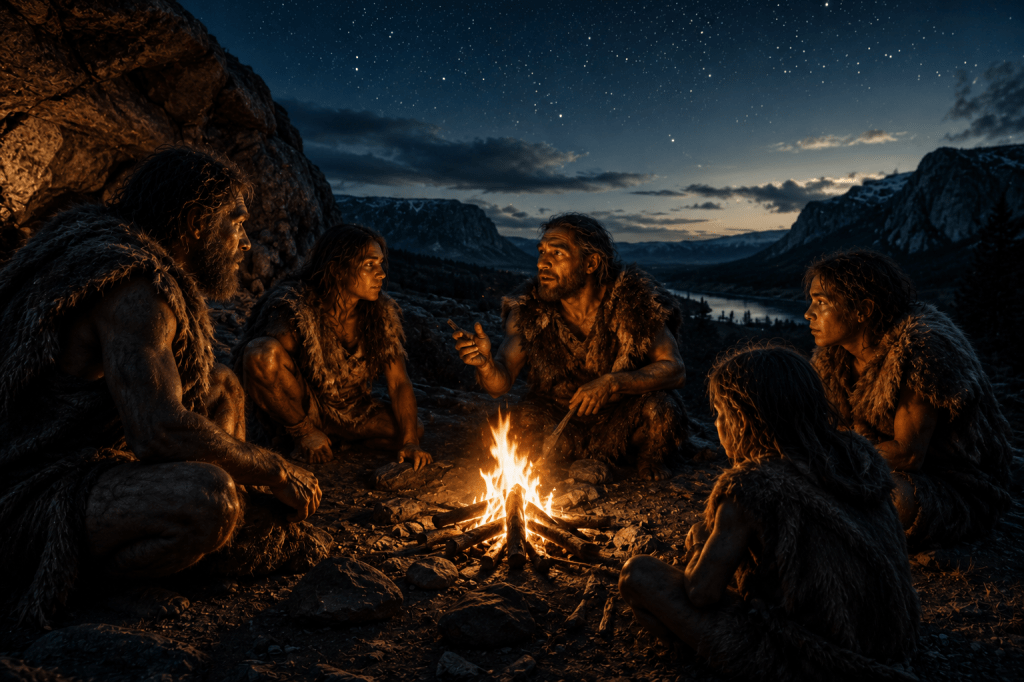
Picture a small group of early humans gathered around a campfire thousands of years ago. The flames of fire provide warmth, protection, and light. For those people, controlling fire was revolutionary. It was perhaps the first time humanity learned to command energy rather than merely endure nature.
Centuries passed.
Humans learned to harness the power of animals, rivers, wind, and eventually steam. The Industrial Revolution arrived, and giant machines powered by coal reshaped the world. Then came electricity, oil, nuclear power, and the digital age.
Each chapter of human civilization tells the same story: our ability to control more energy has expanded our possibilities.
In many ways, the history of humanity is the history of energy.
And this is exactly why Kardashev believed energy could serve as a universal yardstick for measuring civilization.
The Cosmic Report Card
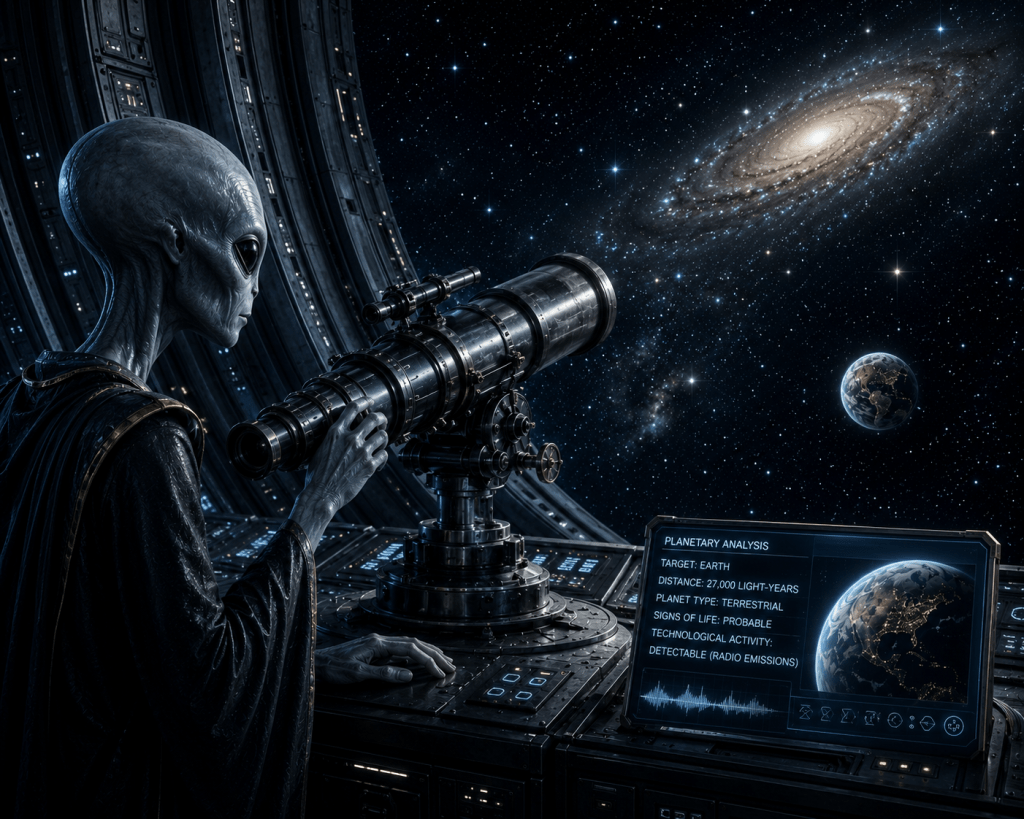
Now imagine an alien astronomer living thousands of light-years away.
Suppose they point a telescope toward Earth.
What would they see?
They would notice a planet glowing with artificial lights at night. They would detect radio waves leaking into space. They might observe satellites orbiting the planet and signs of industrial activity.
Impressive?
Yes.
But on the cosmic scale, not particularly.
According to Kardashev’s classification, humanity has not yet achieved Type I status. We are still a developing planetary civilization, using only a fraction of the energy available to us.
Think of it as being in the first chapter of a very long book.
The exciting part is that the remaining chapters have not yet been written.
Becoming a Type I Civilization
Imagine a future where every rooftop is a power station.
Solar panels stretch across deserts. Offshore wind farms spin endlessly. Advanced fusion reactors provide clean and abundant energy. Weather forecasting becomes so precise that hurricanes and droughts can be anticipated and managed with unprecedented accuracy.
Energy shortages become a memory of the past.
This is the world of a Type I Civilization.
For the first time in history, humanity would fully utilize the energy resources of an entire planet.
The achievement would not merely change technology, it would transform society itself.
Conflicts over energy resources could diminish. Clean water could become universally available. Scientific research could flourish on a scale never before seen.
Yet even this remarkable future would represent only the beginning.
Reaching for the Sun
Thousands of years later, humanity might look at the Sun differently.
No longer as a distant star, but as an energy source waiting to be tapped.
Imagine billions of solar collectors orbiting the Sun, capturing a significant portion of its energy output. Vast space habitats drift peacefully through the Solar System. Cities float in orbit around planets and moons.
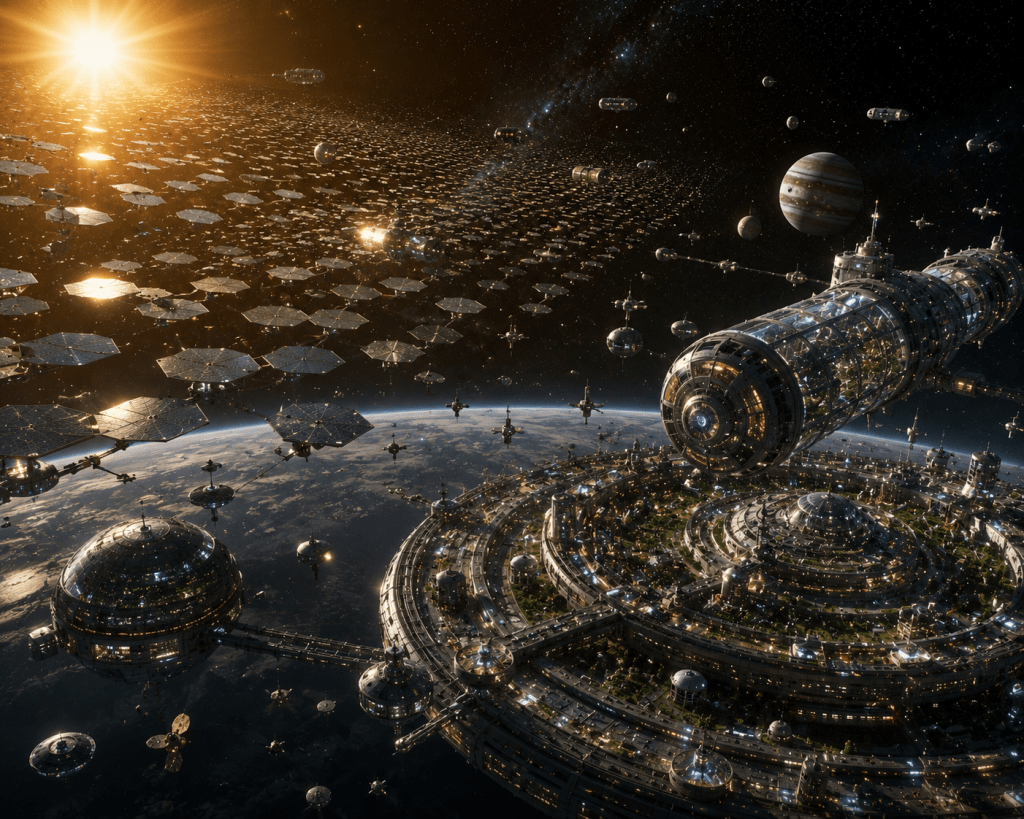
This is the realm of a Type II Civilization.
At this stage, humanity would command energy levels so immense that today’s global consumption would seem insignificant, much like a campfire appears insignificant beside a modern power plant.
The descendants of future humans might study our era with curiosity and wonder.
They might ask:
“Did people really burn ancient fossilized plants and animals for energy?”
Just as we marvel at Stone Age tools today.
Masters of the Galaxy
Now let your imagination travel even further.
Millions of years into the future.
Humanity or perhaps another intelligent species has spread across the Milky Way. Entire star systems have become homes. Energy is collected from billions of stars. Interstellar travel is routine.
At this point, a civilization has become Type III.
Such beings might reshape planets, move stars, and undertake engineering projects so vast that our current scientific achievements would seem almost invisible by comparison.
To them, our most advanced technologies might look as primitive as stone tools appear to us.
And yet, perhaps they too would look up at the night sky and wonder whether there are civilizations beyond their reach.
The Most Fascinating Possibility
The greatest mystery of the Kardashev Scale is not where humanity might go.
It is whether someone has already arrived.
Somewhere among the hundreds of billions of stars in our galaxy, there may already exist a civilization that has crossed milestones we can barely imagine.
Perhaps they have mastered the energy of their star.
Perhaps they command the power of an entire galaxy.
Or perhaps they are asking the same question we ask every night:
“Are we alone?”
Until we find the answer, the Kardashev Scale remains more than a scientific theory. It is a reminder that humanity’s story is still being written and that the next chapter may be far grander than anything we have imagined so far.
The Kardashev Scale:
The original scale had three levels:
1. Type I Civilization
Can use all the energy available on its home planet.
Approximate power level: ~10^16 to 10^17 W
Humanity is currently estimated around Type 0.7–0.75.
2. Type II Civilization
Can harness the total energy output of its star (often imagined with a “Dyson Sphere”).
Approximate power level: ~10^26 W
3. Type III Civilization
Controls energy on the scale of an entire galaxy.
Approximate power level: ~10^36 W
Why Kardashev Matters
Kardashev’s ideas became foundational in:
the search for extraterrestrial intelligence (SETI),futurism,
astroengineering concepts,and discussions about humanity’s long-term technological future.
His framework influenced scientists and science fiction writers alike, including discussions around:
Dyson spheres,galactic civilizations,
megastructures,and post-planetary societies.


Leave a Reply