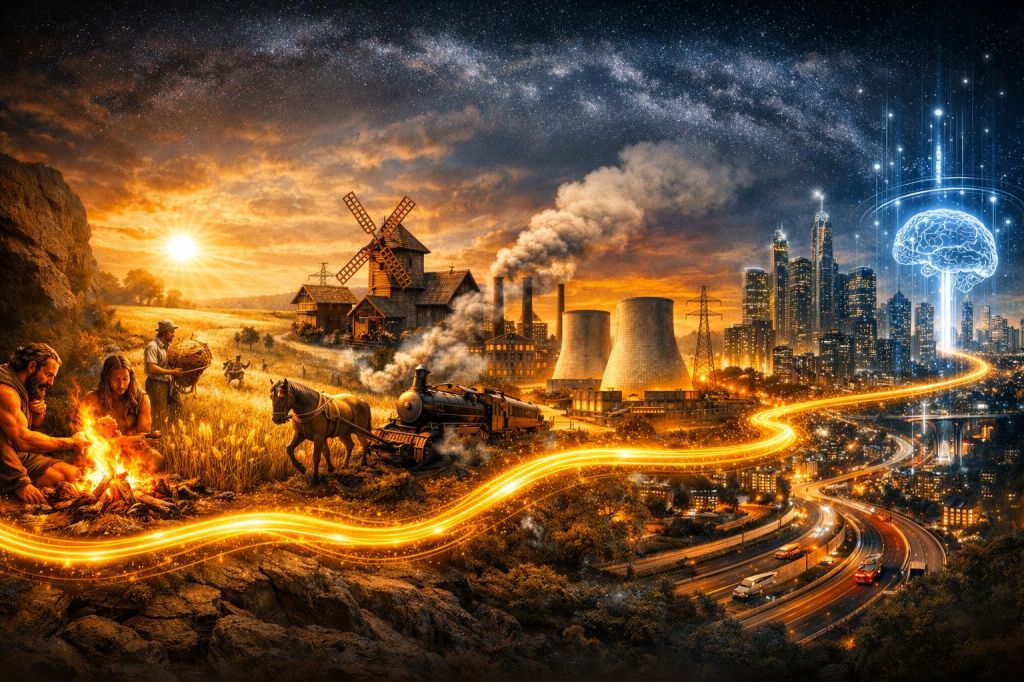
The invention of how to capture, store, and control energy shaped everything from fire and agriculture to electricity, artificial intelligence, and the modern world.
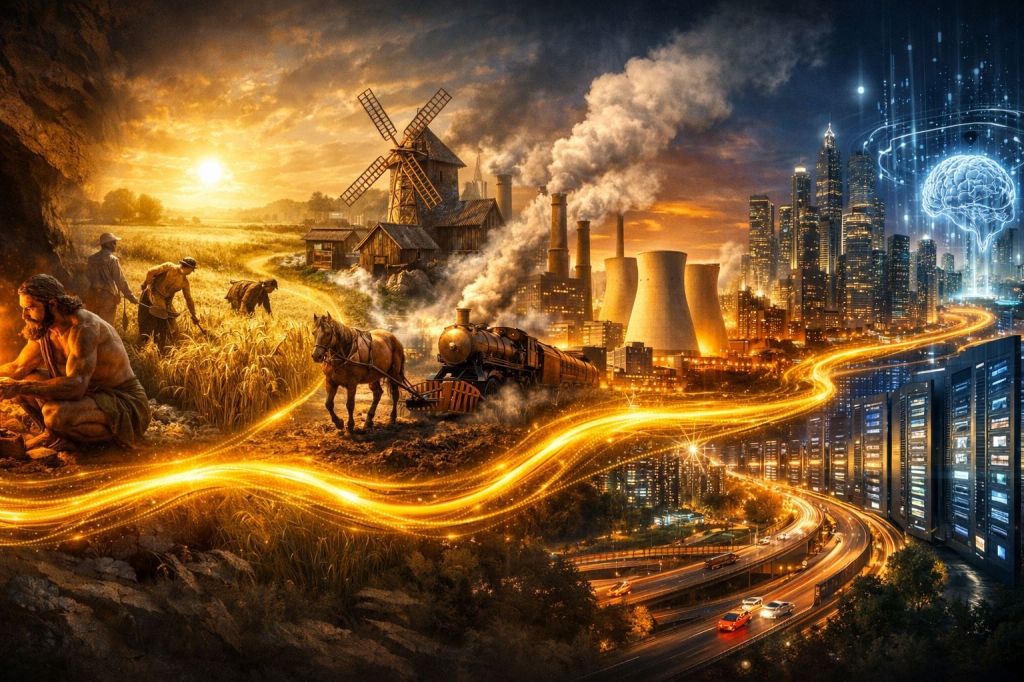
“What is the history of mankind? “
Most people who answer this question will talk about kings, wars, empires, religions, science, and technology. But if we go a little deeper, perhaps the whole story is summed up in a single word: “Energy”.
When I started reading “Sapiens”, I thought I was reading the story of human evolution. But as the pages progressed, I began to see a different story. It was a story of constant transformation of energy.
The history of mankind is perhaps more a history of energy than a political or social history. Who are we? Where do we live? What do we eat? How do we travel? And how did we get to artificial intelligence today? It is all based on energy.
If you read “Sapiens” from the “point of view of energy,” then the whole human history really appears as a narrative of obtaining, storing and controlling energy.
Yuval Noah Harari speaks mainly of three revolutions:
The Cognitive Revolution
The agricultural revolution
The scientific revolution
But if we look at it through the lens of energy, it looks like this:
1. The hunter-gatherer era: the energy of the human body
2. The Agricultural Revolution: Solar Energy
3. The use of animal power
4. The Industrial Revolution: the invention of fossil fuels
5. The scientific revolution: the efficiency of energy conversion
6. The digital age: information and energy
To put “Sapiens” in one sentence in the language of energy: human history is the story of capturing an increasing amount of energy, transforming it into a useful form and creating more complex societies through it.
In the beginning, when man was just an animal
Several million years ago, our early human ancestors lived very simple lives and relied almost entirely on their own muscles for energy. He had no cities, no books, no science.His life was very simple.
Sunlight provides energy to plants.Plants are food for the animals. Animals are food for humans.
This was a simple energy series:
Sun → Plant → Animal → Human
Man had no source of energy except his muscles. He was running. He was hunting. He was collecting fruits. Life was all about getting and using energy every day.
Fire: the first energy revolution
Perhaps the greatest invention in human history was not the wheel but fire. Fire gave humans control over natural energy for the first time. The man who used the fire caused by lightning in the forest gradually learned to light the fire.
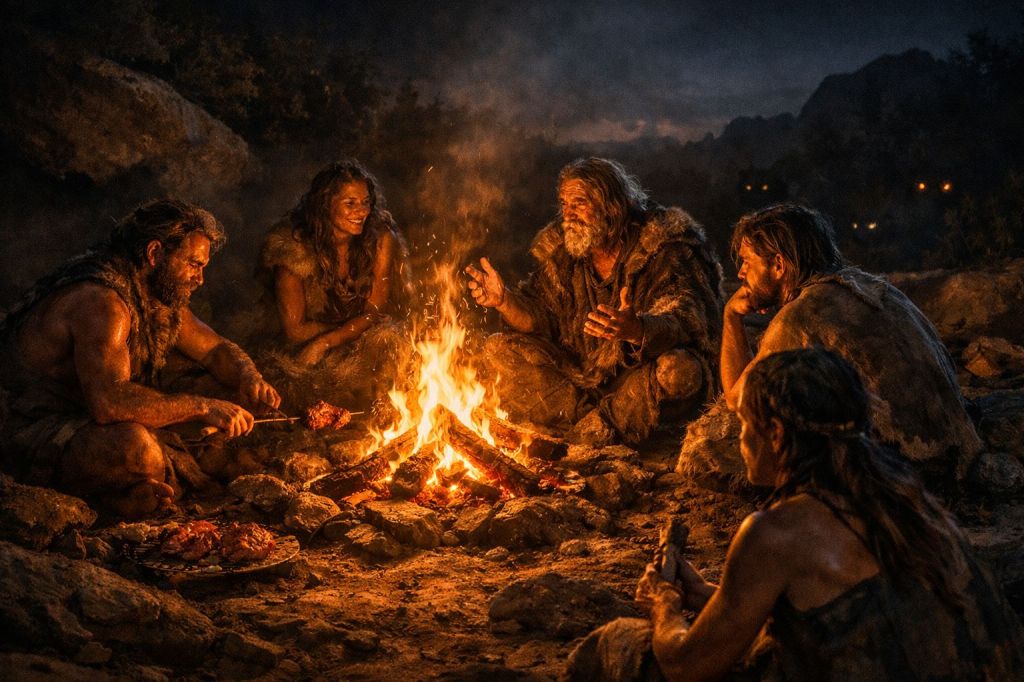
In the glow of the first fire, humanity found warmth, safety, and the spark of civilization
The fire brought three major changes:
1.It made food easy to digest and get more calories.
2.It enabled humans to survive in colder climates and expand into new environments.
3. It provided protection from predators and wild animals.
Fire was not just heat, it was the first external energy source controlled by humans.
The cognitive revolution: what is more important than energy?
Harari says that about 70,000 years ago a major change occurred in the human brain.
But from the point of view of energy, the significance of this change was somewhat different. Humans gained the ability to share information, and information became a means of obtaining energy. Language allowed humans to coordinate large groups. Cooperation enabled bigger hunting, food sharing,collective defense, and eventually agriculture, trade, and government. Information became a tool for directing energy.
Man was limited to a solitary hunter,
Even ten people planning, strategizing and hunting together can get a lot more energy. This was made possible by the development of language. This is where the true power of humanity begins.
Agriculture: Humanity’s First Energy Bank
Humans began farming about 12,000 years ago.
It is generally considered to be the beginning of human civilization. But from the point of view of energy, agriculture was a method of storing sunlight.
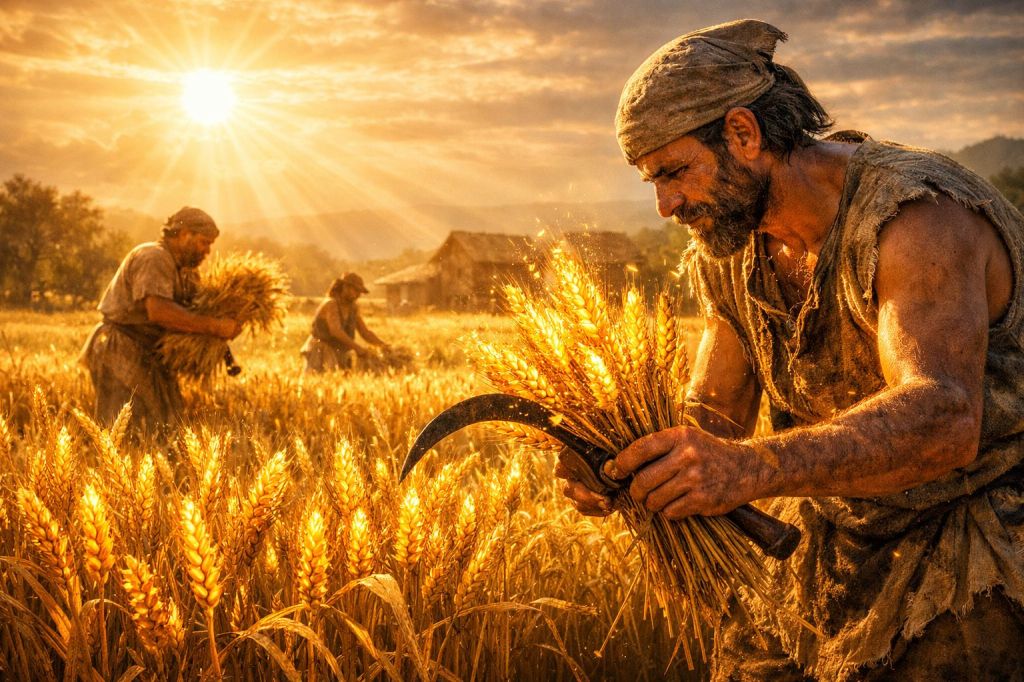
Farmers plant seeds in the ground. Sunlight is stored in the crop. Then the crop is turned into cereals.Cereals can be stored for a long time.Agriculture was an energy bank.
For the first time, humans were able to save energy for the future. As a result, people moved from villages to cities.
When extra food became available, there was no need to cultivate everything. That’s why some people became artisans, some became soldiers, some became merchants, some became rulers.Duties were distributed among people.
All of this was possible because of the extra energy.Behind every great city there was an additional energy.Pyramids, temples, palaces were all visible forms of energy storage.
Animal power: living machines
Then humans started using horses, bulls and camels. These animals were, in fact, living engines.One bullock could do as much work as many men. A horse can run faster than a man. This was the second major energy revolution.
Now man is not dependent only on his muscles.The power of human muscles is atleast 100 watt, while the horse muscle power is atleast 750 watt. Human is found more energy for their works.
Power of wind and water
The windmill and watermill are among the greatest inventions in human history. This was the first time that humans used natural forces other than animals. Rivers were grinding cereals. The wind was driving the ships. So the business grew. Cultures intertwined as trade grew. Cities on faraway continents began to come closer and the world began to become smaller.
The Industrial Revolution: The Explosion of Hidden Solar Energy
What exactly is coal and petroleum?
It is the solar energy stored in the plants and animals that lived on Earth millions of years ago. Man suddenly discovered this treasure of energy.And then it all changed. The steam engine came. The railway arrived. Factories were set up, and the world exploded in production. This was perhaps the greatest energy revolution in human history. One barrel of oil contains roughly the energy equivalent of several years of human physical labor.
Electricity: a universal form of energy
Electricity is not a source of energy. It is a way of transporting energy, and the effect was amazing.
Now the energy can be sent thousands of kilometers away, it can turn into light, can turn into sound, It can also be converted into information. The modern world cannot exist without electricity.
The nuclear age
After 1945, man discovered the hidden energy within matter. Nuclear reactions release millions of times more energy per unit mass than chemical reactions such as burning coal or oil. This was a major leap in the understanding of energy in human history.
For the first time, humans were able to generate energy similar to the processes occurring in stars.
The digital age: is information the new energy?
Today we are living in the era of information.But behind every information there is energy.
Your mobile, your internet, cloud server and AI model. It is all based on electricity. Data is often called the new oil. But in reality data is also useless without energy.
Artificial Intelligence and Energy
There is a lot of discussion about AI. But there’s an interesting question: What really drives AI?
The answer is: “Energy“.
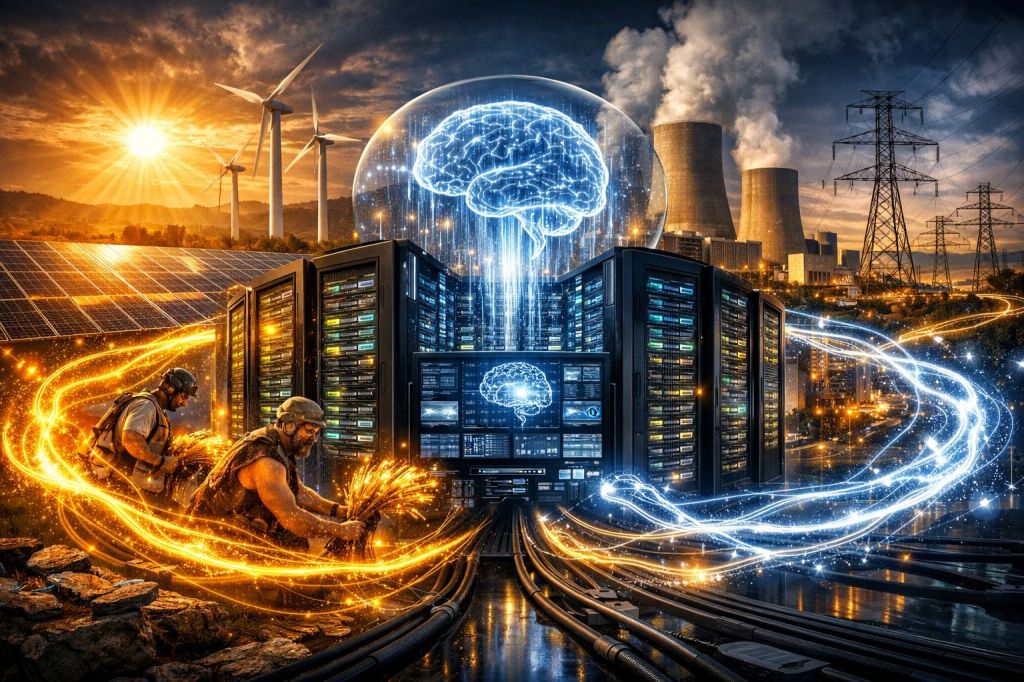
Data centers around the world use billions of units of electricity. The development of AI in the future will depend on the availability of energy.
The energy revolution of the future
Modern civilization consumes over 600 exajoules of energy annually. Energy availability remains one of the central challenges for humanity, both today and in the future.Perhaps the biggest question for mankind in the next century will be:
“Where do we get the energy from? “
Possible answers:
Solar energy,
Wind energy,
Fusion energy,
Space-based energy systems
The society that gets the cleanest and cheapest energy will be ahead in the future.
How does energy make civilization more complex?
The development of human civilization is fundamentally a story of the increasing use of energy. As humans became more energy-efficient, they were able to produce more food. More food fed a larger population, and a larger population made specialization possible. As a result, not everyone needed to farm; some became artisans, merchants, teachers, scientists, soldiers, and rulers. This specialization led to new inventions and technological developments that made energy use more efficient and society more complex and organized.
Thus,
More energy → more food → more people → more specialization → more technology → more advanced civilization
The cycle continues. From ancient farming villages to today’s world powered by electricity, the internet, and artificial intelligence (AI), every major step in human civilization has been based on the ability to capture, store, and use energy more efficiently.
Civilization advances not only by finding new energy sources but also by using energy more efficiently. From improved ploughs to modern computers, technological progress often means accomplishing more work with the same amount of energy.
Final Thought
If we tried to explain human history in a single sentence, perhaps it would be this:
“The progress of mankind is a continuous journey to acquire more and more energy, store it and transform it into a useful form. “
Sapiens from this point of view is not only the history of mankind. It is a story of energy.
From the first spark of fire to the servers of artificial intelligence, behind every achievement of man stands a single invisible hero: “That is energy.”
References
Harari, Y. N. (2014). Sapiens: A Brief History of Humankind. Harper.
Smil, V. (2017). Energy and Civilization: A History. MIT Press.
Diamond, J. (2006). The Third Chimpanzee: The Evolution and Future of the Human Animal. Harper Perennial.
Diamond, J. (1997). Guns, Germs, and Steel: The Fates of Human Societies. W. W. Norton & Company.


Leave a Reply